
Mostly not, for the part that pays for a physical injury. Federal law leaves out of your income “the amount of any damages (other than punitive damages)” received “on account of personal physical injuries or physical sickness”, whether you get it in a lump sum or in payments over time (26 U.S.C. 104(a)(2)). That covers medical bills, pain and suffering, and wages lost while you were hurt. But parts of a settlement or court award can be taxable: punitive damages, interest, money for emotional distress with no physical injury behind it, and any medical costs you already deducted on an earlier tax return. This page goes through each part, using the IRS’s own publications, and is part of our guide to bills, liens, fees and tax.
This page is general information, not legal, tax or medical advice, and not a substitute for the advice of an attorney. Injury law and deadlines vary by state and change. Ask a lawyer or the court about your situation.
For how your own settlement is taxed, ask a tax professional, such as a CPA or an enrolled agent, who can read your settlement papers and your past returns.
The answer, part by part
The IRS’s one-page summary, Publication 4345, “Settlements—Taxability” (Rev. 9-2023), starts from a simple idea: whether you pay tax “depends on all the facts and circumstances in your case.” Publication 525 (2025) puts it another way: look at “the item that the settlement replaces.” Money that replaces something tax-free stays tax-free. Money that replaces income, or that is not compensation at all, is usually taxed.
| Part of the money | Federal income tax | Where the rule is |
|---|---|---|
| Medical bills, pain and suffering, and other compensation for a physical injury or physical sickness | Not taxable | 26 U.S.C. 104(a)(2); Pub 4345 |
| Wages lost because the physical injury kept you off work | Not taxable | 104(a)(2); Commissioner v. Schleier (1995); IRS Chief Counsel Advice 201346010 |
| Emotional distress that comes from the physical injury | Not taxable | 104(a); Treas. Reg. 1.104-1(c); Pub 4345 |
| Medical costs you deducted on an earlier return | Taxable, to the extent the deduction cut your tax | 104(a); Pub 4345; Pub 502 |
| Emotional distress with no physical injury or sickness behind it | Taxable, less medical costs for the distress | 104(a); Pub 4345 |
| Punitive damages | Taxable, even in a physical injury case (one narrow wrongful death exception) | 104(a)(2), 104(c); Pub 4345 |
| Interest on a settlement or award | Generally taxable | Pub 4345; Pub 525 |
| Back pay or lost wages in an employment case, such as discrimination | Taxable as wages | Pub 4345 |
| Lost business profits | Taxable as business income, with self-employment tax | Pub 4345 |
| Damage to your car or other property | Not taxable up to your adjusted basis; any excess is income | Pub 4345 |
| Wrongful death money | No IRS rule read that states it directly; see below | 104(a)(2), 104(c) |
You may see “settlements are tax-free” on many pages. That is true only for the compensation for a physical injury or physical sickness, as the rows above show.
Why money for a physical injury is tax-free
Section 104(a)(2) of the Internal Revenue Code is the rule. Its words matter, so here they are in full: gross income does not include “the amount of any damages (other than punitive damages) received (whether by suit or agreement and whether as lump sums or as periodic payments) on account of personal physical injuries or physical sickness.”
Four things follow from that sentence:
- Settlement or verdict, it doesn’t matter. “By suit or agreement” covers a court judgment and a deal reached with the insurer without a lawsuit.
- Lump sum or payments over time, it doesn’t matter. A structured settlement, where the money comes in instalments, falls under the same words.
- “Any damages” means all the compensation, not only the medical bills. The IRS regulation repeats the statute’s words and defines damages as money received (other than workers’ compensation) through a lawsuit or “a settlement agreement entered into in lieu of prosecution” (Treas. Reg. 1.104-1(c)).
- The injury must be physical. Congress added the word “physical” in 1996 (Public Law 104-188, section 1605). Before that, the text said only “on account of personal injuries or sickness”.
Publication 4345 puts it plainly for most car crash and fall cases: if you got a settlement for a physical injury and did not deduct the medical costs for it on an earlier return, “the full amount is non-taxable. Do not include the settlement proceeds in your income.” The same publication still treats any interest and punitive damages as taxable, as set out below.
Lost wages after a physical injury
Some pages say lost wages in an injury settlement are always taxed, because wages are normally taxed. For a physical injury, the IRS reads it the other way.
The Supreme Court used a car crash to explain the rule in Commissioner v. Schleier, 515 U.S. 323 (1995). A driver hurt in an accident has medical expenses, lost wages, and pain and suffering, and settles for $30,000. The Court said that, if she had not already deducted her medical expenses, the entire $30,000 would be excluded, and that “the recovery for lost wages is also excludable as being ‘on account of personal injuries,’ as long as the lost wages resulted from time in which the taxpayer was out of work as a result of her injuries.” The case was decided under the older wording, before “physical” was added, but a car crash injury meets both.
An IRS Chief Counsel memo released in 2013 says the same under today’s wording: once damages are received on account of a physical injury, “all compensatory damages, including lost wages, are excludable from gross income under section 104(a)(2)” (CCA 201346010). Chief Counsel advice is not binding precedent, but it shows how the IRS reads the statute.
Where does the “lost wages are taxed” idea come from? Publication 4345 says lost wages are taxable wages in “an employment-related lawsuit; for example, for unlawful discrimination or involuntary termination.” That is a different kind of case: the money replaces pay you lost because of how an employer treated you, not because an injury kept you home. Publication 525 also lists lost wages as income “in most cases” in its general list, and then says, “Don’t include in your income compensatory damages for personal physical injury or physical sickness.”
Emotional distress: physical injury or not
The statute says emotional distress is not, by itself, a physical injury or physical sickness. So the question is where the distress came from.
- Distress that comes from a physical injury is treated the same as the injury: not taxable. Anxiety and lost sleep after a crash that broke your wrist fall here (Pub 4345; Treas. Reg. 1.104-1(c)).
- Distress with no physical injury behind it is taxable. Publication 525 gives unlawful discrimination and injury to reputation as examples. You can subtract what you paid for medical care for the distress, unless you already deducted that care on an earlier return and the deduction cut your tax (Pub 4345).
- Physical symptoms of distress don’t change this. Publication 525 says emotional distress “includes physical symptoms that result from emotional distress, such as headaches, insomnia, and stomach disorders.” Headaches caused by distress don’t turn a distress claim into a physical injury claim.
This matters most for claims where nobody was physically hurt, and in cases with both kinds of harm. If a settlement covers a physical injury and a separate non-physical claim, the money for each can be taxed differently.
Medical costs you already deducted
Section 104(a) has one exception built in: the exclusion doesn’t cover amounts for medical expenses you deducted in an earlier year. You can’t get the tax benefit twice. Publication 4345 says you must include in income “that portion of the settlement that is for medical expenses you deducted in any prior year(s) to the extent the deduction(s) provided a tax benefit,” and report it as other income on Schedule 1.
Many people never meet this rule. Medical costs are deductible only if you itemize, and only the part above 7.5% of your adjusted gross income for 2025 returns (Publication 502 (2025); the same publication notes a 10% limit applied in some earlier years). If you took the standard deduction in the year you paid the bills, or your costs never got over the 7.5% line, there was no deduction to give back. Publication 502 says that if you didn’t deduct a medical expense, you don’t include a reimbursement for it in income, up to the amount of the expense.

Two details from Publication 502 are easy to miss:
- An unallocated settlement pays the deducted bills first. In its example, a person deducted $500 of medical costs, then settled for $2,000 without saying what the money was for. “The $2,000 is first presumed to be for the medical expenses that you deducted,” so the $500 is income.
- Money for future medical care uses up future deductions. If part of a settlement is for future medical expenses, you can’t deduct those future costs for the same injury until that part is used up. In the IRS example, $10,000 of a $45,000 settlement was for future medical care, so the first $10,000 of later medical costs for those injuries can’t be deducted.
Punitive damages and interest
Punitive damages are meant to punish the person at fault, not to repay a loss. Section 104(a)(2) carves them out in its own words, “(other than punitive damages)”, and Publication 4345 says they are taxable “even if the punitive damages were received in a settlement for personal physical injuries or physical sickness.”
There is one narrow exception, in section 104(c). It covers punitive damages in a wrongful death action where the state’s law, as it stood on 13 September 1995, provided (or had been read by a court by that date to provide) “that only punitive damages may be awarded in such an action.” It stops applying to suits filed once the state’s law changes. We have not read which states, if any, still qualify. A tax professional can say whether it reaches a particular case.
Interest is generally taxable. Publication 4345: “Interest on any settlement is generally taxable as ‘Interest Income’.” When a judgment or settlement includes interest, that interest is income even if the damages it sits on are not.
Car and property damage
Money for damage to your car or other property follows a different rule. Publication 4345 says a property settlement that is less than your adjusted basis is not taxable and generally doesn’t need to be reported, but you must reduce your basis by the amount. If the payment is more than your adjusted basis, the excess is income. The basis of property you buy “is usually its cost”, then adjusted over time (Publication 551, Rev. December 2025). For a car that has been driven for some years, the payout is often below what was paid for it, so there is no excess, but that is a sum to check, not a rule. If your car was written off, see what happens when a car is totaled but still drivable.
Wrongful death and survival claims
Publication 4345 doesn’t mention wrongful death, and we found no IRS publication that states directly how compensatory wrongful death money is taxed. You will see pages that say flatly that it is tax-free. What we can say from the texts we read:
- Section 104(a)(2) speaks of damages received “on account of personal physical injuries or physical sickness.” Whether a family’s wrongful death recovery falls under those words is a question for a tax professional, not one we can answer in general.
- Punitive damages in a wrongful death case are taxable unless the narrow 104(c) exception above applies.
- Interest is generally taxable whatever the claim.
A death can lead to two claims: a wrongful death claim for the family’s losses and a survival claim for what the person who died could have claimed. Our page on wrongful death and survival actions explains the difference, and who gets wrongful death money covers how it is divided by state. Estate tax is a separate question again. If any of the money passes through an estate, the executor and a tax professional should look at income and estate tax together.
What the settlement papers say about it
A settlement can be split into parts in the written agreement: so much for the physical injury, so much for something else. Publication 4345 says the IRS “will not disturb an allocation if it is consistent with the substance of the settled claims.” The key words are “consistent with the substance”. Labelling money as injury compensation doesn’t make it so if the claim was really about something else.

In a plain car crash or fall case, where the only claim is for the physical injury, the wording rarely changes much. It matters more when a case mixes claims: an injury plus an employment dispute, a physical injury plus a separate distress claim, or a judgment with punitive damages and interest. Those are the cases where a tax professional’s review of the draft agreement, before it is signed, is most useful.
Lawyer fees and tax
For the tax-free part of a physical injury settlement, the lawyer’s fee raises no tax question: the whole amount is excluded, including the share that goes to the lawyer.
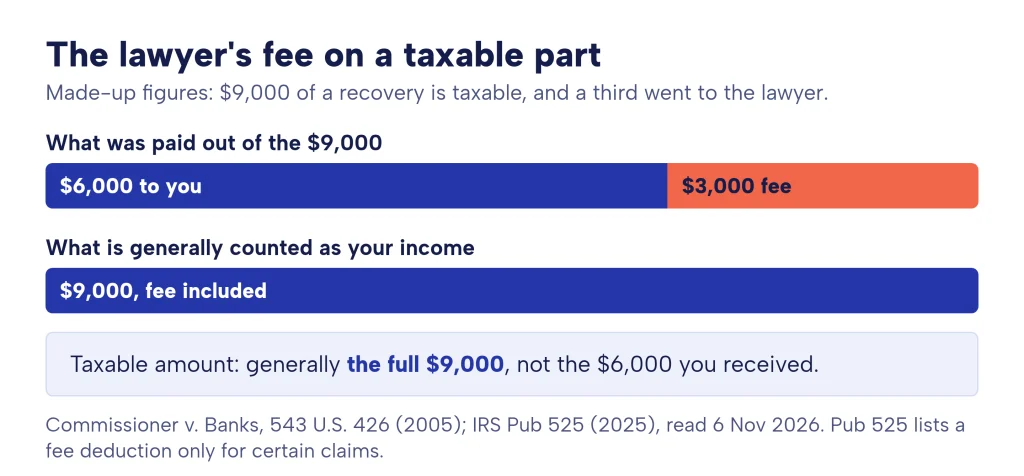
For any taxable part, the fee can be a trap. The Supreme Court held in Commissioner v. Banks, 543 U.S. 426 (2005) that, “as a general rule, when a litigant’s recovery constitutes income, the litigant’s income includes the portion of the recovery paid to the attorney as a contingent fee.” Publication 525 lists attorney fees and costs, “including contingent fees”, as income where the underlying recovery is income. So, to take made-up figures, if $9,000 of a recovery is taxable and a third went to the lawyer, the taxable amount is generally the full $9,000, not the $6,000 you received. Publication 525 describes a deduction for fees and costs only in certain cases: claims of unlawful discrimination, claims against the US government, claims under section 1862(b)(3)(A) of the Social Security Act (part of the Medicare secondary payer rules), and whistleblower awards. Whether any other deduction is open to you is one for a tax professional.
To see how fees, costs and liens come off a settlement line by line, use our what you keep calculator. Repaying a health plan, Medicare or Medicaid from a settlement is not a tax, but it does reduce what you keep; medical liens explains who can claim what.
Forms 1099: who gets one, and what it means
Under the IRS’s Instructions for Forms 1099-MISC and 1099-NEC (Rev. December 2026):
- A business that pays you taxable damages reports them, generally in box 3 of Form 1099-MISC. The instructions list punitive damages “even if they relate to physical injury or physical sickness” and damages for non-physical injuries. For tax years beginning after 2025, the reporting threshold is $2,000.
- A payer does not report damages (other than punitive damages) received on account of personal physical injuries, or damages up to the medical care paid for emotional distress, or distress damages that come from a physical injury.
- Your lawyer may get a form for the whole check. When an insurer pays a settlement to the claimant’s lawyer, it reports the payment to the lawyer as gross proceeds in box 10, at $600 or more. The instructions’ own example: an insurer pays a claimant’s attorney $100,000 to settle a claim and reports $100,000 in box 10.
A Form 1099 is a payer’s report, not a ruling on your tax. The rules above decide what is taxable. If you get a 1099 for money you think is excluded, or don’t get one for money you think is taxable, a tax professional can explain how to handle it on your return.
A worked example
These are made-up round numbers, to show how the rules fit together. They are not a guide to what any claim is worth.
Example: a court judgment after a car crash in which the plaintiff broke a leg. The jury awards $40,000 in compensatory damages and $10,000 in punitive damages, and $2,000 of interest is added before the money is paid. In an earlier year, the plaintiff itemized and deducted $1,500 of medical bills for the injury, and the whole deduction cut their tax. The compensatory award includes those bills.
| Part (example figures) | Amount | Taxable? |
|---|---|---|
| Compensatory damages, less the medical costs deducted earlier | $38,500 | No |
| Medical costs deducted earlier, with a full tax benefit | $1,500 | Yes |
| Punitive damages | $10,000 | Yes |
| Interest | $2,000 | Yes |
| Total | $52,000 | $13,500 taxable, $38,500 not |
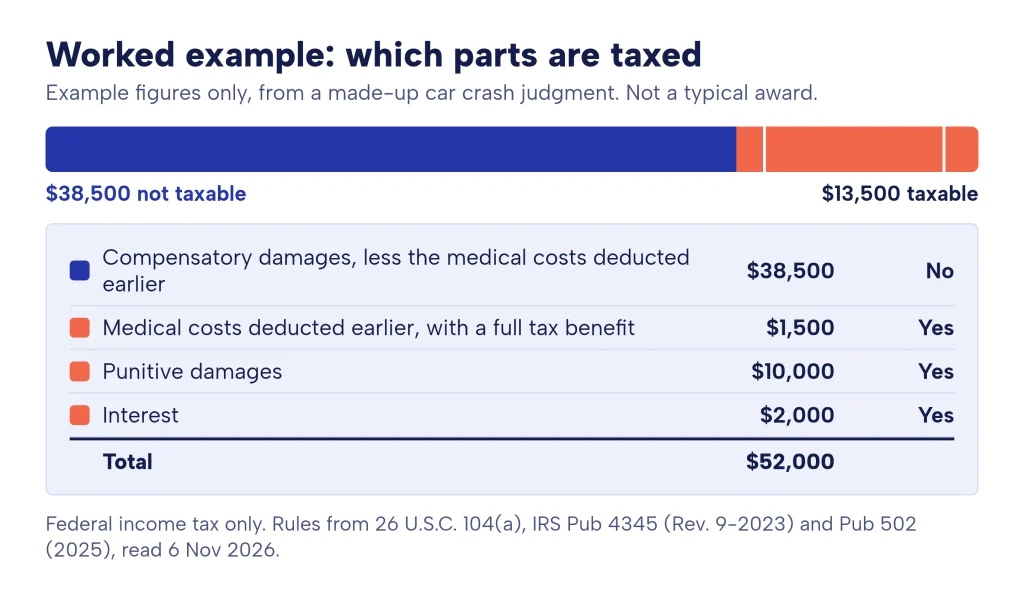
If a lawyer took a contingency fee out of the whole $52,000, the Banks rule above means the taxable $13,500 is counted before the fee comes off. The tax due on $13,500 depends on the person’s whole return; the example stops at the taxable amount.
Estimated tax, health coverage and state tax
- Estimated tax. If part of the money is taxable and nothing was withheld, Publication 4345 says you may need to make estimated tax payments if you expect to owe $1,000 or more after credits and withholding. Publication 505 and Form 1040-ES explain how.
- Marketplace health coverage. If you or your family get advance premium tax credits through the Health Insurance Marketplace, Publication 4345 asks you to tell the Marketplace about a taxable settlement that raises your income, so the credit can be adjusted.
- Means-tested benefits. Programs such as SSI and Medicaid have their own rules on settlement money that are separate from income tax. We haven’t covered them here; ask the agency or a benefits adviser before the money arrives.
- State income tax. This page covers federal income tax only. Each state sets its own income tax rules, and we haven’t read them. A tax professional in your state can tell you how it treats each part.
What to do next
If your settlement is for a physical injury only, includes no interest or punitive damages, and you never deducted the medical bills, the IRS’s own summary says the full amount is non-taxable. If any of the other parts above apply, gather these before you talk to a tax professional:
- The settlement agreement and release, or the court judgment, showing any split between compensatory damages, punitive damages and interest.
- The closing statement from your lawyer, if you had one, showing fees, costs and liens paid from the money.
- Your returns for the years you paid medical bills, to see whether you itemized medical expenses on Schedule A.
- Any Form 1099 you or your lawyer received for the payment.
- Notes on any part of the claim that wasn’t about a physical injury, such as an employment or distress claim.
If you haven’t signed yet and the case mixes claims, ask your lawyer and a tax professional to look at how the agreement describes the payment before you sign. For the IRS’s own words, read Publication 4345 first, then the “Court awards and damages” section of Publication 525. The IRS’s general help line is 1-800-829-1040. For how a settlement is put together in the first place, see how car accident settlements work.
Sources checked on 6 November 2026: 26 U.S.C. 104 and Treas. Reg. 1.104-1 (Cornell LII copies); IRS Publication 4345 (Rev. 9-2023); Publication 525 (2025); Publication 502 (2025); Publication 551 (Rev. December 2025); Instructions for Forms 1099-MISC and 1099-NEC (Rev. December 2026); IRS Chief Counsel Advice 201346010; Commissioner v. Schleier, 515 U.S. 323 (1995); Commissioner v. Banks, 543 U.S. 426 (2005).
Sources
- 26 U.S.C. 104, Compensation for injuries or sickness (Cornell LII copy, read 6 Nov 2026)
- Treas. Reg. 1.104-1(c), Damages received on account of personal physical injuries (Cornell LII copy, read 6 Nov 2026)
- IRS Publication 4345, Settlements—Taxability (Rev. 9-2023)
- IRS Publication 525, Taxable and Nontaxable Income (2025 returns)
- IRS Publication 502, Medical and Dental Expenses (2025 returns)
- IRS Publication 551, Basis of Assets (Rev. December 2025)
- IRS Instructions for Forms 1099-MISC and 1099-NEC (Rev. December 2026)
- IRS Chief Counsel Advice 201346010 (released 15 Nov 2013)
- Commissioner v. Schleier, 515 U.S. 323 (1995)
- Commissioner v. Banks, 543 U.S. 426 (2005)