
The money from a wrongful death case goes to the close family members that the state’s wrongful death statute names, not to whoever is named in the will, and usually not into the estate. In most of the states we read, that means the spouse and children first, then the parents, and in some states brothers, sisters or anyone who depended on the person who died. How it’s split depends on the state: some statutes set fixed shares, some follow the state’s inheritance rules, and many leave the split to a jury or a judge, based on what each person lost. The person who files the lawsuit, often the executor or administrator, is usually not the person the money is for.
This page is general information, not legal, tax or medical advice, and not a substitute for the advice of an attorney. Injury law and deadlines vary by state and change. Ask a lawyer or the court about your situation.
This page is part of our guide to wrongful death claims. There is no national rule on who gets the money. We read the wrongful death statute of 40 states and DC in official text on 6 November 2026, and the table below gives each one with its citation. For the other states the table says “not confirmed”: we couldn’t read the official text, so we don’t guess. If you are dealing with a death right now, the time limit matters more than the split. Check it first with our deadline lookup by state, and read our page on wrongful death deadlines.
Who files and who gets paid are different questions

Every wrongful death statute answers two questions, and families often mix them up.
- Who brings the case. In most states we read, it’s the personal representative: the executor named in a will, or an administrator the probate court appoints when there is no will. Some states let family members sue directly. In Texas the spouse, children or parents may sue “for the benefit of all”, and the executor or administrator steps in only if none of them has started within three calendar months, unless all of them ask the executor not to (Civ. Prac. & Rem. Code 71.004). North Dakota sets an order: spouse, then children, then a parent, a grandparent, the personal representative, and then a person who had primary physical custody of the person who died (N.D. Cent. Code 32-21-03). Minnesota uses a trustee appointed by the court on a petition from the spouse or next of kin (Minn. Stat. 573.02).
- Who the money is for. The statute names the beneficiaries. The person who files is acting for them. Washington’s statute shows how this works: the personal representative sues for the damages “sustained by the beneficiaries listed in RCW 4.20.020” (RCW 4.20.010).
So an executor who is also a stepchild, a friend or a family lawyer doesn’t keep the money because they filed. And a family member who isn’t the executor still has a claim to a share if the statute names them. If no personal representative has been appointed yet, the probate court in the county where the person lived is usually where that starts. Our sister site explains how an executor or administrator is appointed.
Wrongful death money is also separate from the money that belongs to the person who died. Many states have a second claim, often called a survival action, for what the person who died could have claimed themselves, such as their own medical bills or pain before death. That money usually goes into the estate and passes under the will or the inheritance rules. Our page on wrongful death and survival claims explains the difference. This page is about the wrongful death share.
Four ways states divide the money
The statutes we read fall into four broad patterns. A few states mix them.
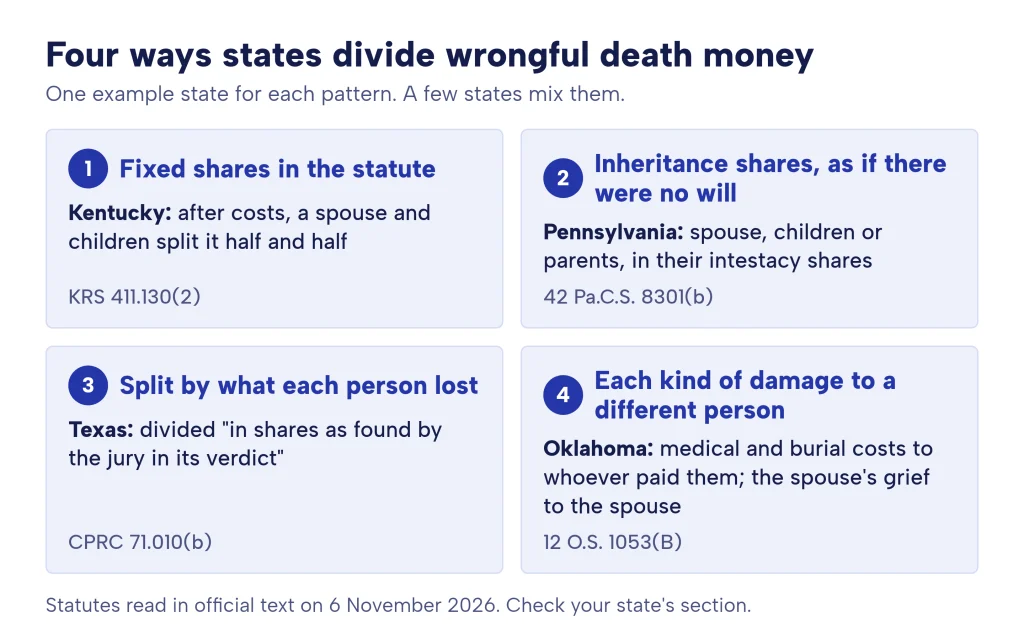
1. Fixed shares written into the statute
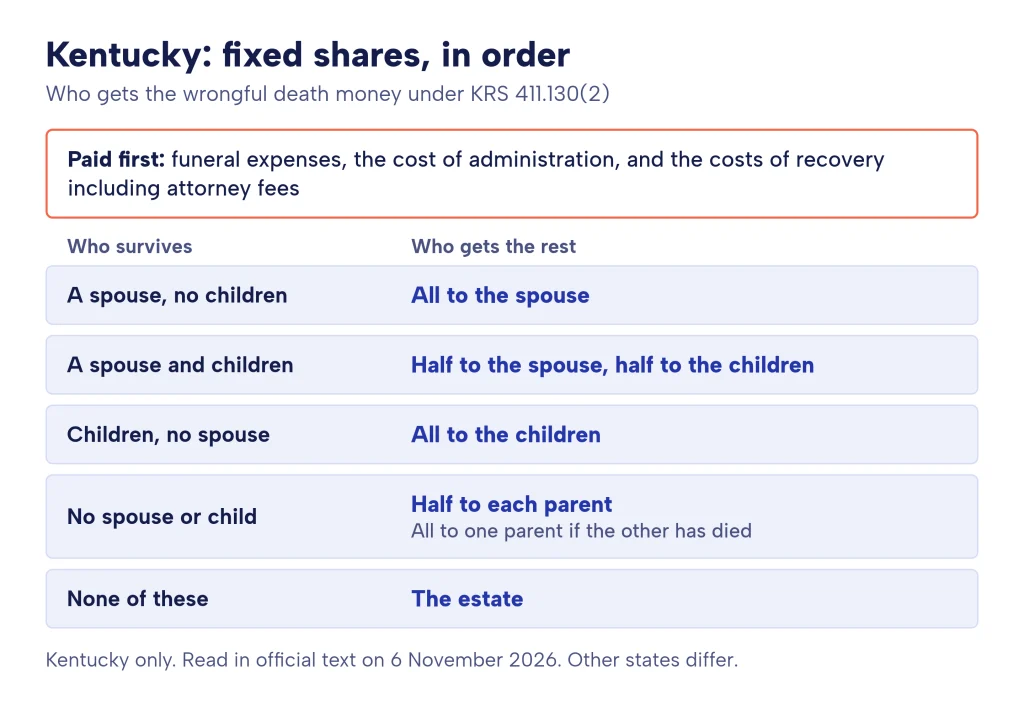
A handful of states spell out the fractions. In Kentucky, after funeral expenses, the cost of administration and the costs of recovery including attorney fees, a spouse with no children takes everything; a spouse and children split it half and half; children with no spouse take everything; and if there is no spouse or child, the parents take one half each, or all of it to one parent if the other has died (KRS 411.130(2)). Rhode Island gives one half to the spouse and one half to the children, all to the spouse if there are no children, and to the next of kin under the intestacy rules if there is no spouse (R.I. Gen. Laws 10-7-2(a)); a separate claim for loss of society and companionship goes to the person who suffered that loss (10-7-2(b)). Massachusetts uses one half to the spouse and one half to one child, or one third to the spouse and two thirds to the children when there is more than one child (M.G.L. c. 229, s. 1, applied to wrongful death damages by s. 2).
2. The state’s inheritance shares, as if there were no will
Many states borrow the shares from their intestacy law, the rules for who inherits when someone dies without a will. The will itself doesn’t decide the split. Pennsylvania limits the beneficiaries to the spouse, children or parents and divides the money in the shares they would take under its intestacy law (42 Pa.C.S. 8301(b)). Maine sends the money to the heirs in intestate shares, after funeral expenses and the costs of recovery including attorney’s fees, “without becoming part of the probate estate” (18-C M.R.S. 2-807(2)). North Carolina, South Carolina and Alabama also point to their intestacy or distribution statutes, and Oregon does for whatever remains after expenses and the shares for each person’s own loss (see the table).
3. Split by what each person lost, decided by a jury or judge
This is the most common pattern in the statutes we read. The statute names who may share, and the jury’s verdict or the judge decides each person’s part according to their loss. In Texas the damages “shall be divided, in shares as found by the jury in its verdict” among the spouse, children and parents who are alive at that time (CPRC 71.010(b)). In New York the personal representative distributes the money to the distributees (the people who would inherit without a will) “in proportion to the pecuniary injuries suffered by them”, after a court hearing (EPTL 5-4.4(a)(1)). “Pecuniary” means financial: lost support, services and the like. Illinois divides by each person’s “percentage of dependency” on the person who died, set by the judge at a hearing (740 ILCS 180/2(b), (i)). In Kansas the judge apportions the net recovery “in proportion to the loss sustained by each of the heirs” after allowing costs and reasonable attorney fees (K.S.A. 60-1905).
In practice, under this pattern a spouse who lost a household income and a grown child living elsewhere can receive very different amounts, and two children can receive different amounts too. Families can often agree on a split, and some statutes say so directly. Michigan lets the court enter an order following a written, verified agreement of all the people entitled, as long as none of them is a minor, a disappeared person or legally incapacitated (MCL 600.2922(6)(e)). Ohio lets beneficiaries who are all equally closely related adjust their shares among themselves; otherwise the court sets them (R.C. 2125.03(A)(1)).
4. Each kind of damage goes to a different person, or to the estate
Some statutes attach each kind of damages to a particular person. In Oklahoma, in short (12 O.S. 1053(B)), after legal expenses and the costs of the action are paid (1053(E)), and with the judge deciding the split where it follows each person’s loss (1053(D)):
- medical and burial expenses go to whoever paid them;
- the spouse’s loss of consortium and grief go to the spouse;
- the pain suffered by the person who died goes to the spouse and children, or the next of kin;
- the financial loss goes to the spouse and children, or the next of kin, according to each one’s financial loss;
- the children’s and parents’ grief and loss of companionship go to them, according to each one’s grief and loss;
- any punitive damages, where allowed, go to the spouse and children, or the next of kin, in the same proportion as the personal property of the person who died (1053(C)).
Florida works the same way: each survivor recovers their own lost support and services; the spouse, minor children (under 25 for this purpose) and all children if there is no spouse recover for lost companionship and mental pain, and some parents for their mental pain; and the personal representative recovers some items, such as lost earnings up to death and medical or funeral costs the estate paid, for the estate (Fla. Stat. 768.21; “minor children” defined in 768.18(2)). Florida has a medical malpractice exception: adult children can’t recover for lost companionship and pain, and parents of an adult child can’t recover for mental pain (768.21(8)). Nevada lets the heirs prove their own damages, which are not liable for the debts of the person who died, while the estate’s share (medical bills, funeral costs and some penalties) is liable for those debts unless exempt (NRS 41.085(4), (5)).
A few states treat the money mainly as estate property. Connecticut’s executor or administrator brings the action (C.G.S. 52-555), and for deaths since 1 October 1961 the money is distributed, after costs of suit, last-illness and funeral bills, administration expenses, claims against the estate and any family allowance the probate court allows, “as personal estate in accordance with the last will and testament of the deceased if there is one” (C.G.S. 45a-448(b)). Iowa treats the damages as estate property, but the part for loss of services and support is apportioned by the court among the spouse, children and parents (Iowa Code 633.336).
What comes off before the family is paid
The share a family member receives is a share of what is left after certain costs. Several statutes set the order, and they don’t all agree.
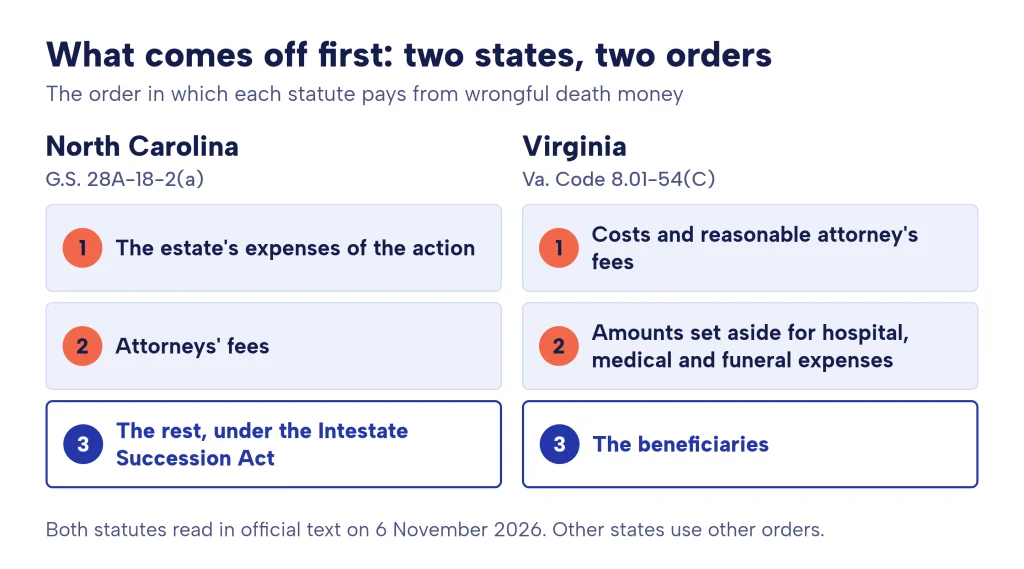
- Lawyer’s fees and case costs. North Carolina repays the estate’s expenses of the action first, then the attorneys’ fees, then distributes the rest (G.S. 28A-18-2(a)). Virginia’s personal representative first pays costs and reasonable attorney’s fees, then the amounts set aside for hospital, medical and funeral expenses, then the beneficiaries (Va. Code 8.01-54(C)). Missouri and Kansas also take out fees and costs before the split (RSMo 537.095(4); K.S.A. 60-1905). To see how a percentage fee and costs change a total, our fee and net amount calculator lays it out line by line with your own figures.
- Funeral and medical bills. Some statutes pay these first, or send them to whoever paid them. Delaware caps the funeral expenses a court or jury may consider at $7,000, or the amount in 29 Del. C. 5546(a) if that is greater (10 Del. C. 3724(d)(4)). North Carolina lets the money be used for burial expenses and for hospital and medical expenses up to $4,500, and the medical amount can’t exceed 50% of the damages after attorneys’ fees (G.S. 28A-18-2(a)).
- Repayment claims (liens). A health insurer, a government program or a hospital may have a right to be repaid from the money. Iowa says so outright for state Medicaid payments made between the injury and the death (Iowa Code 633.336). Our page on medical liens explains how these claims work.
Tax is a separate question. IRS Publication 4345 (Rev. 9-2023), on settlements, doesn’t mention wrongful death, so we don’t state a rule; our page on whether injury settlements are taxed covers what the IRS does say, and a tax professional can apply it.
Does the will matter? Can creditors take it?

In most states we read, the will doesn’t decide who gets wrongful death money: the statute does. Connecticut is the clear exception (45a-448, above). Michigan lets people named in the will claim a share alongside the family: its list includes devisees under the will, beneficiaries of a trust under the will, and people the will designates as entitled to wrongful death damages (MCL 600.2922(3)(c)). In West Virginia the will comes in only if none of the listed survivors exists (W. Va. Code 55-7-6(b)).
Many of the statutes also keep the money away from the dead person’s creditors, usually with exceptions for funeral and last-illness costs. Some examples, all read 6 November 2026:
- Alabama: the damages “are not subject to the payment of the debts or liabilities” of the person who died (Code 6-5-410(c)).
- Virginia: distributions are “free from all debts and liabilities of the decedent” (8.01-54(C)).
- Wyoming: if the person who died left a husband, wife, child, father or mother, no debt of theirs may be paid from the proceeds (W.S. 1-38-102(b)).
- DC: the damages may not be used to pay the debts of the person who died, except the amount for the last illness and burial (D.C. Code 16-2703).
- Hawaii: the damages are not part of the estate, except the amount for the last illness and burial (HRS 663-3(b)).
Not every state works this way. Alaska’s section says the money is distributed “only after payment of all costs and expenses of suit and debts and expenses of administration” (AS 09.55.580(a)); the court handling the estate can say what that covers in a given case. In Florida, awards to the estate (not to the survivors) are subject to the claims of creditors who followed the probate rules (768.21(7)). In Connecticut, claims against the estate are paid before the will or intestacy rules apply. If the person who died owed money, our sister site’s page on what happens to debt after a death explains the estate side.
Court approval, hearings and claim deadlines inside the case
Because the money belongs to several people, many states make a court approve a settlement or the split. South Carolina says any settlement of a wrongful death or survival action “must be approved” by a probate court, circuit court or federal district court (S.C. Code 15-51-41). In Nebraska a personal representative may not settle until the appointing court has approved the terms, and the money is distributed after a hearing with published notice (Neb. Rev. Stat. 30-810). In New York, Vermont, Minnesota and Kansas a court also sets the shares (see the table).
Two of the statutes we read set deadlines inside the case that can cost a family member their share, or their right to be told about the settlement. Other states may have similar rules in their court rules or probate law:
- Michigan. Anyone who may be entitled to damages “must present a claim for damages to the personal representative on or before the date set for hearing on the motion for distribution”, and failing to do so bars them from the proceeds (MCL 600.2922(7)). They must also tell the personal representative’s attorney about relevant facts within 60 days after being served with the complaint and notice, or the court may bar their claim (600.2922(8)).
- Ohio. For deaths on or after 4 April 2023, a spouse, child or parent is always an “interested person” entitled to notice of the settlement and distribution. Other next of kin lose that status if the application is filed more than two years after the death, unless they filed a written notice of claim with the probate court within those two years (R.C. 2125.02(B)).
Children’s shares get extra protection in several states. In Maine a settlement on behalf of minor children isn’t valid unless the court approves it (18-C M.R.S. 2-807(2)). An Ohio court may put the share of a beneficiary under 25 in trust until they turn 25 (R.C. 2125.03(A)(2)).
Who can be left out
Being related isn’t always enough. The statutes we read cut people out in these cases, among others:
- A parent who abandoned the child. Louisiana treats a parent who abandoned the person who died during their minority as not having survived them (C.C. art. 2315.2(E)). Ohio bars a parent who abandoned a minor child who died (R.C. 2125.02(A)). Vermont gives no share to a parent who neglected or refused to provide for the child or abandoned them, unless parental duties were resumed (14 V.S.A. 1492(c)(4)). South Carolina lets the probate court deny or limit a parent’s share for failing to support the child during minority (S.C. Code 15-51-40).
- A parent behind on child support. Rhode Island bars a person adjudged in willful contempt for being more than six months behind on child support for the person who died (R.I. Gen. Laws 10-7-2(a)).
- A parent whose rights were terminated. Virginia excludes a parent whose parental rights were terminated by a court or by a permanent entrustment agreement (Va. Code 8.01-53(A)).
- A person who killed the person who died. Alaska (09.55.580(f)), Arizona (A.R.S. 12-612(D)), and Nevada (NRS 41.085(1)) bar the person responsible for the killing, in the cases their statutes describe. In Maryland, where a suit over a child’s death caused by a parent is allowed under Cts. & Jud. Proc. 5-806, it can’t benefit that parent, and the same goes for a child who caused a parent’s death (Cts. & Jud. Proc. 3-904(a)(3)).
Illinois also reduces or bars a beneficiary’s own share if that beneficiary’s fault helped cause the death: reduced if their fault is not more than 50%, barred if it is more, and the barred share doesn’t go to the other beneficiaries (740 ILCS 180/2(h)).
Who gets the money, state by state
Every row was read in the official statute text on 6 November 2026, unless it says “not confirmed”. The table summarizes; the statute has the exact words, the exceptions and the definitions (who counts as a “child” or “next of kin”, for example). “Not stated in the section” means the section we read doesn’t answer that part; another law or a court rule may.
| State | Who brings the case | Who the money is for, and how it’s split | Statute (read 6 Nov 2026) |
|---|---|---|---|
| Alabama | Personal representative | Not subject to the debts of the person who died; distributed under the statute of distributions | Code of Ala. 6-5-410(a), (c) |
| Alaska | Personal representatives | Spouse and children, or other dependants; if none, administered as estate property but limited to financial loss. Distributed “only after payment of all costs and expenses of suit and debts and expenses of administration” | AS 09.55.580(a) |
| Arizona | Spouse, child, parent, guardian or personal representative | Spouse, children or parents, in proportion to their damages; if none, the estate | A.R.S. 12-612 |
| Arkansas | Not confirmed. We couldn’t read the official text. Ask the clerk of court or a lawyer in the state. | Not read | |
| California | The listed persons, or the personal representative on their behalf | Spouse, domestic partner, children and issue of deceased children; if none, those who would inherit. Also, if dependent: putative spouse, the putative spouse’s children, stepchildren, parents. Also a minor who lived in the home for the previous 180 days and depended on the person for half or more of their support. How it’s split: not stated in the section | Code Civ. Proc. 377.60 |
| Colorado | Not confirmed. We couldn’t read the current official text. | Not read | |
| Connecticut | Executor or administrator | After costs, last-illness and funeral bills, administration expenses, claims against the estate and any family allowance: under the will, or intestacy if there is none | C.G.S. 52-555, 45a-448(b) |
| Delaware | Not stated in the section | Spouse, parent, child and siblings; if none, anyone related by blood or marriage. Shares set by the verdict | 10 Del. C. 3724 |
| District of Columbia | Personal representative | Spouse or domestic partner and next of kin, as the verdict allocates, or under the statute of distribution if it doesn’t. Not used for debts, except last illness and burial | D.C. Code 16-2701, 16-2702, 16-2703 |
| Florida | Personal representative | Each survivor recovers their own listed damages; some items go to the estate, which are subject to creditors | Fla. Stat. 768.20, 768.21 |
| Georgia | Not confirmed. We couldn’t read the official text. | Not read | |
| Hawaii | Legal representative, or any listed person | Spouse, reciprocal beneficiary, children, father, mother and anyone wholly or partly dependent. Jury or court allocates. Not part of the estate, except last illness and burial | HRS 663-3 |
| Idaho | Heirs, or personal representatives on their behalf | “Heirs”: those who would inherit, plus spouse, children, stepchildren, parents, dependent blood relatives and a dependent putative spouse. How it’s split: not stated in the section | Idaho Code 5-311 |
| Illinois | Personal representatives | Spouse and next of kin, by each person’s percentage of dependency, set by the court | 740 ILCS 180/2 |
| Indiana | Not confirmed. We couldn’t read the official text. | Not read | |
| Iowa | Not stated in the section | Estate property, but loss of support and services is apportioned by the court among spouse, children and parents (parents after spouse and children). Not subject to estate debts if a spouse, child or parent survives, except state Medicaid repayment | Iowa Code 633.336 |
| Kansas | Any heir who suffered a loss, for all of them | Heirs who suffered a loss; the judge apportions the net, after costs and fees, by each heir’s loss | K.S.A. 60-1902, 60-1905 |
| Kentucky | Personal representative | Fixed order, after funeral, administration and recovery costs: spouse alone if no children; half spouse, half children; children alone; parents; then the estate | KRS 411.130 |
| Louisiana | Spouse and children; if none, parents; then siblings; then grandparents | Each person in the first class that exists sues for the damages they sustained | La. C.C. art. 2315.2 |
| Maine | Personal representative or special administrator | Heirs in intestate shares, after funeral and recovery costs, outside the probate estate | 18-C M.R.S. 2-807 |
| Maryland | Not stated in the section | Spouse, parent and child; if none, a relative by blood or marriage who was substantially dependent. Shares set by the verdict | Cts. & Jud. Proc. 3-904 |
| Massachusetts | Executor or administrator | Fixed shares: spouse alone if no children; half and half with one child; one third and two thirds with more; next of kin if no spouse | M.G.L. c. 229, s. 1, s. 2 |
| Michigan | Personal representative | Spouse, children, descendants, parents, grandparents, siblings (if none, intestate heirs), the spouse’s children, and people named in the will, who suffered damages. Court sets shares after a hearing; claims must be presented in time | MCL 600.2922 |
| Minnesota | Trustee appointed by the court | Spouse and next of kin, in proportion to each one’s financial loss; funeral expenses paid first | Minn. Stat. 573.02 |
| Mississippi | Not confirmed. We couldn’t read the official text. | Not read | |
| Missouri | Spouse, children, descendants of deceased children or parents; if none, siblings or their descendants; if none, a plaintiff ad litem | Court apportions by each person’s losses; with a plaintiff ad litem, by the laws of descent unless that would be inequitable | RSMo 537.080, 537.095 |
| Montana | Personal representative | Not confirmed: the section we read doesn’t name the beneficiaries | MCA 27-1-513 |
| Nebraska | Personal representative | Widow or widower and next of kin, in proportion to each one’s financial loss; court approval and a hearing | Neb. Rev. Stat. 30-810 |
| Nevada | Heirs and the personal representative may each sue | Heirs (those who would inherit) for their own damages; the estate for medical, funeral and some penalties | NRS 41.085 |
| New Hampshire | Not confirmed. The official site refused our reads. | Not read | |
| New Jersey | Not confirmed. We couldn’t read the official text. | Not read | |
| New Mexico | Not confirmed. We couldn’t read the official text. | Not read | |
| New York | Personal representative | Distributees, in proportion to financial loss, set after a hearing; parents count when there is a spouse and parents but no children or other descendants | EPTL 5-4.1, 5-4.4 |
| North Carolina | Personal representative or collector | Action expenses, then attorneys’ fees, then under the Intestate Succession Act; limited use for burial and medical bills | G.S. 28A-18-2 |
| North Dakota | In order: spouse, children, parent, grandparent, personal representative, a person with primary physical custody | Heirs at law, in shares the judge fixes; not liable for debts | N.D. Cent. Code 32-21-03, 32-21-04 |
| Ohio | Personal representative | Spouse, children and parents (presumed damaged) and other next of kin; court adjusts shares equitably unless all are equally related and agree | R.C. 2125.02, 2125.03 |
| Oklahoma | Personal representative | By kind of damage (see above) | 12 O.S. 1053 |
| Oregon | Personal representative | Spouse, children, parents, intestate heirs, stepchildren and stepparents. Costs and medical, burial and memorial charges first; shares for financial loss and loss of companionship apportioned by loss; the rest in intestate shares or as agreed, not subject to claims against the estate | ORS 30.020, 30.030 |
| Pennsylvania | Not stated in the section | Spouse, children or parents only, in intestate shares, free of the creditors of the person who died. If none of them survives, the personal representative may sue only for medical, funeral and administration expenses | 42 Pa.C.S. 8301 |
| Rhode Island | Executor or administrator | Half spouse, half children; all to spouse if no children; next of kin if no spouse. A separate claim for loss of society and companionship under 10-7-1.2 is brought by, and goes to, the person who suffered that loss | R.I. Gen. Laws 10-7-2 |
| South Carolina | Executor or administrator | Spouse and children; if none, parents; if none, heirs. Intestate shares; court approval of settlements | S.C. Code 15-51-20, 15-51-40, 15-51-41 |
| South Dakota | Personal representative | Spouse and children; if neither, parents and next of kin. How it’s split: not stated in the section | SDCL 21-5-5 |
| Tennessee | Not confirmed. We couldn’t read the official text. | Not read | |
| Texas | Spouse, children or parents (any one for all); executor or administrator after 3 calendar months unless all ask not to | Spouse, children and parents; the jury divides it | CPRC 71.004, 71.010 |
| Utah | Heirs, or personal representatives for them | “Heirs”: spouse, children, parents, minor stepchildren who were supported or lived with the person; if none of spouse, children or parents, blood relatives under intestacy. How it’s split: not stated in the section | Utah Code 78B-3-105, 78B-3-106 |
| Vermont | Personal representative | Spouse and next of kin, in proportion to financial loss, after a court hearing; spouse alone if no children | 14 V.S.A. 1492 |
| Virginia | Personal representative | Ordered classes (spouse, children and grandchildren first; dependent parents in some cases; then parents, siblings and dependent household relatives); verdict or court sets shares | Va. Code 8.01-50, 8.01-53, 8.01-54 |
| Washington | Personal representative | Spouse, registered domestic partner, children including stepchildren; if none, parents or siblings. How it’s split: not stated in the section | RCW 4.20.010, 4.20.020 |
| West Virginia | Personal representative | Jury or court may set shares among spouse, children (including adopted and stepchildren), siblings, parents and financial dependants; if none, the will or intestacy | W. Va. Code 55-7-6 |
| Wisconsin | Not confirmed. We couldn’t open the official text. | Not read | |
| Wyoming | Wrongful death representative appointed by the court | Beneficiaries who sustained damage, each proving their own; no debts paid from it if a spouse, child or parent survives | W.S. 1-38-102 |
For a “not confirmed” state, the clerk of the court where a case would be filed, the state’s court self-help pages, or a lawyer licensed in that state can point to the statute. We don’t fill these rows from law firm pages, because those summaries are often out of date or leave out exceptions.
Claims you may see elsewhere
- “The money is split equally among the family.” True in some situations, under a few fixed-share statutes. In many states the shares follow each person’s loss, so equal shares aren’t automatic.
- “It goes to the estate, so the will decides.” Usually not. Of the statutes we read, Connecticut’s is the one that sends it through the will whenever there is one.
- “The executor gets the money.” The executor or administrator often files the case and handles the money, but for the beneficiaries the statute names.
- “A typical wrongful death settlement is $X.” We found no public dataset of wrongful death settlement amounts, so we don’t give one. Our wrongful death damages worksheet lets a family list and add up its own losses, without guessing at an outcome.
What to do next
- Check the deadline first. Wrongful death limits run from the death or the injury, and claims against a government body can need written notice within months. Start with the deadline lookup linked near the top of this page, then confirm with the court or a lawyer.
- Find the state’s statute in the table and read the section itself. The state that matters is usually where the death or injury happened, but where a case can be filed and which law applies can be a legal question in its own right.
- Write down the family. List the spouse or partner, children (including adopted and stepchildren), parents, siblings and anyone who depended on the person who died, with their ages. That is what the statute, the court and any lawyer will ask about first.
- Find out who is, or will be, the personal representative. If no one has been appointed, the probate court clerk in the county where the person lived can explain how that starts.
- Keep the bills and records. Funeral receipts, medical bills and proof of what the person contributed to the household matter, both for the claim and for any split based on loss.
- Ask before you sign. If an insurer offers to settle, or family members disagree about shares, a lawyer licensed in the state or the court handling the estate can explain whether court approval is needed and how the split is decided. Legal aid organizations help some families who can’t pay. Our page on how wrongful death lawsuits work covers the rest of the process.
Sources checked on 6 November 2026. Each state row was read in the official statute text on that date, through the legislature’s own website; Illinois was read through the General Assembly’s official statute repository. Laws change: check the linked section before relying on it.
Sources
- Code of Alabama 6-5-410
- Alaska Statutes 09.55.580
- Arizona Revised Statutes 12-612
- California Code of Civil Procedure 377.60
- Connecticut General Statutes 52-555
- Connecticut General Statutes 45a-448
- Delaware Code, Title 10, 3721-3725
- D.C. Code 16-2701
- D.C. Code 16-2702
- D.C. Code 16-2703
- Florida Statutes 768.18 (2026)
- Florida Statutes 768.20 (2026)
- Florida Statutes 768.21 (2026)
- Hawaii Revised Statutes 663-3
- Idaho Code 5-311
- 740 ILCS 180/2
- Iowa Code 633.336 (2026)
- Kansas Statutes 60-1902
- Kansas Statutes 60-1905
- Kentucky Revised Statutes 411.130
- Louisiana Civil Code art. 2315.2
- Maine Revised Statutes, Title 18-C, 2-807
- Maryland Courts and Judicial Proceedings 3-904
- Massachusetts General Laws c. 229, s. 1
- Massachusetts General Laws c. 229, s. 2
- Michigan Compiled Laws 600.2922
- Minnesota Statutes 573.02
- Missouri Revised Statutes 537.080
- Missouri Revised Statutes 537.095
- Montana Code Annotated 27-1-513 (2025)
- Nebraska Revised Statutes 30-810
- Nevada Revised Statutes 41.085
- New York EPTL 5-4.1
- New York EPTL 5-4.4
- North Carolina G.S. 28A-18-2
- North Dakota Century Code ch. 32-21
- Ohio Revised Code 2125.02
- Ohio Revised Code 2125.03
- Oklahoma Statutes, Title 12, 1053
- Oregon Revised Statutes 30.020, 30.030
- 42 Pa.C.S. 8301
- Rhode Island General Laws 10-7-2
- South Carolina Code 15-51-10 to 15-51-42
- South Dakota Codified Laws 21-5-5
- Texas Civil Practice and Remedies Code ch. 71
- Utah Code 78B-3-105
- Utah Code 78B-3-106
- Vermont Statutes, Title 14, 1492
- Code of Virginia 8.01-50
- Code of Virginia 8.01-53
- Code of Virginia 8.01-54
- Revised Code of Washington 4.20.010
- Revised Code of Washington 4.20.020
- West Virginia Code 55-7-6
- Wyoming Statutes 1-38-102