Many car accident lawyers work on a contingency fee: a percentage of whatever is recovered, set in the agreement you sign, usually with no fee if nothing is recovered (costs can be another matter). No national law sets that percentage; a few state and federal rules cap it. What reaches you is the settlement minus the fee, minus the case costs the lawyer advanced, minus anyone with a legal right to be repaid from it, such as Medicare, Medicaid, a health plan or a hospital. Whether the fee is taken before or after costs changes the result, so your agreement should say which.
This page is general information, not legal, tax or medical advice, and not a substitute for the advice of an attorney. Injury law and deadlines vary by state and change. Ask a lawyer or the court about your situation.
In our guide to bills, liens, fees and tax, this calculator takes a settlement apart line by line using only the numbers you enter: the gross amount, the fee percentage in your agreement, the costs, the liens and Medicare’s claim. The result is an estimate of what is left. It does not say what a claim is worth, whether an offer is good, or what a lawyer should charge.
How to use the calculator
Each box matches a line you will find in one of four papers: the fee agreement, the settlement statement (sometimes called a closing or disbursement statement), the lien letters, and any letter from Medicare.
- Settlement or award: the gross figure in the release or the settlement statement, before anything comes off.
- Fee percentage: from your signed agreement. An agreement can set different percentages for settlement, trial or appeal, so use the one for the stage your case ended at.
- Fee taken on: the gross amount, or the amount left after costs. The agreement should say which.
- Case costs: money the lawyer paid out to run the case and is repaid from the settlement, from an itemized list.
- Liens and repayment claims: the final amounts owed to a health plan, Medicaid, a hospital or other provider, or your own insurer. Use final figures, not the first letter.
- Medicare: the conditional payments Medicare made for this injury, before any reduction. The calculator can apply the reduction federal rules give for fees and costs (explained below).
- Anything else: any other amount you agreed would be paid from the settlement.
- Fee rule comparison: optional. It sets your fee beside the maximum in one of the few fee rules we read in the official text: Michigan, Connecticut, and claims against the United States.
Every result is an estimate. If the total paid out is larger than the settlement, what is left shows as a negative number, which can happen when bills are large and the settlement small.
A worked example
This page is general information, not legal, tax or medical advice, and not a substitute for the advice of an attorney. Injury law and deadlines vary by state and change. Ask a lawyer or the court about your situation.
The numbers below are a made-up example, not a typical settlement, fee or lien.
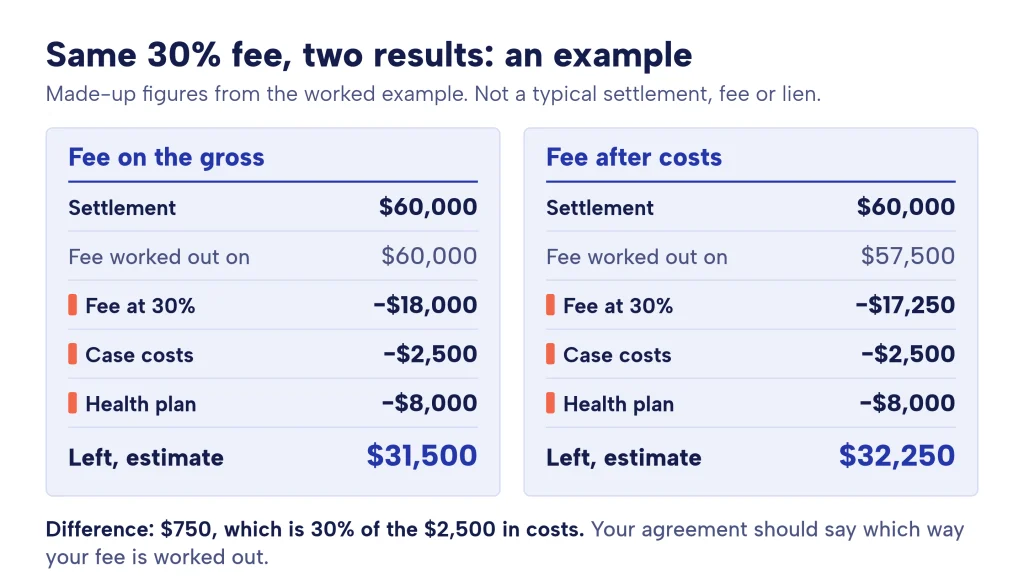
Say a claim settles for $60,000. The agreement says 30%, taken on the gross. The lawyer advanced $2,500 in costs, and a health plan’s final repayment letter asks for $8,000. Medicare paid nothing. These are the calculator’s starting numbers.
| Line | Fee on the gross | Fee after costs |
|---|---|---|
| Settlement | $60,000.00 | $60,000.00 |
| Amount the fee is worked out on | $60,000.00 | $57,500.00 |
| Fee at 30% | −$18,000.00 | −$17,250.00 |
| Case costs | −$2,500.00 | −$2,500.00 |
| Health plan repayment | −$8,000.00 | −$8,000.00 |
| Left, estimate | $31,500.00 | $32,250.00 |
| Share of the gross | 52.50% | 53.75% |
The same agreement percentage gives two different fees. The gap is always the fee percentage times the costs, so it grows with expensive cases: at the same 30%, $25,000 in expert and deposition costs would make the difference $7,500.
Fee before or after costs: what the rules say
Each state sets its own conduct rules for lawyers, and many follow the American Bar Association’s Model Rules. Model Rule 1.5(c) expects a contingent fee agreement to be in writing and signed by the client, to give the percentage for settlement, trial or appeal, to list the expenses that will come out of the recovery, and to say whether those expenses are deducted before or after the fee is calculated. It also expects the agreement to tell the client which expenses they must pay even if they lose, and, at the end, a written statement showing how the money was divided (ABA Model Rule 1.5, read 6 November 2026). Each state adopts its own version, so the wording in your state can differ.
Some states put this in statute or court rule:
- California requires a written contingency fee contract, with a signed copy to the client, that includes “a statement as to how disbursements and costs incurred in connection with the prosecution or settlement of the claim will affect the contingency fee and the client’s recovery”. Outside medical negligence cases, it must also say that the fee “is not set by law but is negotiable between attorney and client”. A contract that doesn’t comply is voidable by the client, and the lawyer is then entitled to a reasonable fee (Bus. & Prof. Code 6147, read 6 November 2026).
- Michigan computes its fee limit for injury, wrongful death and no-fault claims “on the net sum recovered after deducting from the amount recovered all disbursements properly chargeable” to the claim, requires the agreement in writing with a copy to the client, and requires the lawyer to tell the client beforehand that other fee arrangements, such as hourly, exist (MCR 8.121(C), (E), (F), read 6 November 2026).
- Connecticut says that for its fee limit, the fee does not include “disbursements or costs incurred in connection with the prosecution or settlement of the claim”, other than ordinary office overhead (Conn. Gen. Stat. 52-251c(h), read 6 November 2026).
The fee limits we read
No national rule caps the fee or sets a percentage for car accident claims in general. Outside the rules below, the percentage is whatever you and the lawyer agree, subject to each state’s professional conduct rules on fees. Each row was read in the official text on 6 November 2026.
| Where and what | Limit | Source |
|---|---|---|
| Michigan: personal injury, wrongful death and no-fault benefit claims | One-third of the amount recovered, worked out after deducting disbursements. More is deemed a “clearly excessive fee”, except fees awarded under MCL 500.3148 or another statute, court rule or common law. Applies to agreements made after 9 July 1981. | MCR 8.121(A), (B), (C), (G) |
| Connecticut: personal injury, wrongful death or property damage occurring on or after 1 October 1987 | 33⅓% of the first $300,000; 25% of the next $300,000; 20% of the next $300,000; 15% of the next $300,000; 10% above $1,200,000. A client may waive this in a substantially complex case, only after the lawyer explains the limits, and only in a written agreement with a set statement, signed and acknowledged before a notary or other authorized person; even then the fee may not exceed 33⅓% and the client can’t be required to repay costs if nothing is recovered. | Conn. Gen. Stat. 52-251c |
| Claims against the United States under the Federal Tort Claims Act, for example a crash caused by a federal employee driving on the job | 25% of a court judgment or a settlement made in a lawsuit; 20% of a settlement made by the agency before suit. Charging more can bring a fine of up to $2,000, prison of up to a year, or both. | 28 U.S.C. 2678; scope in 28 U.S.C. 1346(b)(1) |
Medical malpractice has its own limits in some states, which don’t apply to a car crash: New York’s sliding scale starts at 30% of the first $250,000 and is worked out after expenses, with no deduction for medical liens before the percentage is applied (Judiciary Law 474-a); Illinois caps the fee at 33⅓% of all sums recovered (735 ILCS 5/2-1114); California allows 25% if settled before a complaint or arbitration demand is filed and 33% after, with more only by motion after a trial or arbitration (Bus. & Prof. Code 6146(a)). All read 6 November 2026.
Not confirmed: New Jersey Court Rule 1:21-7 and Florida Bar Rule 4-1.5 both deal with contingent fees, but neither official site opened for us on 6 November 2026, so we show no figures from them. Ask the state’s courts or bar. We have not read the fee rules of other states.
You may see “a third”, “33% to 40%” or similar described on law firm pages as the standard car accident fee. We looked for a statute or a public dataset of fees actually charged and didn’t find one, so we don’t give a typical percentage.
Case costs
Costs are the money a case uses up, separate from the lawyer’s time: court filing fees, medical records, police reports, expert witnesses, deposition transcripts and similar items. When the lawyer pays them as the case goes along, they are repaid from the settlement. Three questions decide how much they matter to you:
- Do they come off before or after the fee? (See the example above.)
- Do you owe them if nothing is recovered? Model Rule 1.5(c) expects the agreement to say so.
- Are they itemized, with what each item was for? The written statement at the end should let you check each one.

Medicare’s claim, and its reduction for fees
If Medicare paid for treatment of the injury, it has to be repaid from the settlement. Federal law says a primary plan “and an entity that receives payment from a primary plan, shall reimburse the appropriate Trust Fund” for Medicare’s payment; interest can be charged if repayment isn’t made within 60 days of notice, and the United States may sue to recover, including from anyone who received the settlement money, with double damages available against the insurer or plan that was responsible for paying (42 U.S.C. 1395y(b)(2)(B)(ii) and (iii), read 6 November 2026).
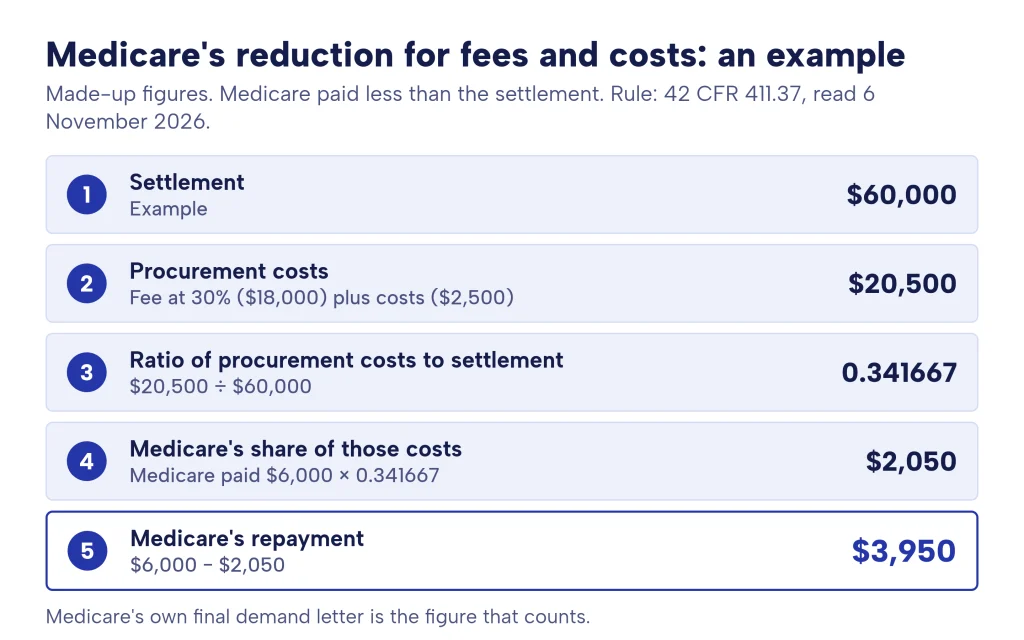
Medicare’s claim is reduced by its share of what it cost to get the settlement. Under 42 CFR 411.37 (read 6 November 2026 in the official eCFR), when the claim was disputed and you bore the costs of procuring the settlement:
- If Medicare paid less than the settlement, take the ratio of procurement costs (the fee and costs) to the settlement, apply it to Medicare’s payment, and subtract the result. That is Medicare’s recovery.
- If Medicare paid as much as the settlement or more, Medicare’s recovery is the settlement minus the total procurement costs.
- If Medicare has to sue because its recovery is opposed, it recovers the lower of its payment or the settlement minus procurement costs.
An example, with made-up figures: a $60,000 settlement, a 30% fee on the gross ($18,000) and $2,500 in costs make $20,500 in procurement costs, a ratio of 0.341667. If Medicare paid $6,000, its share of those costs is $2,050, so the repayment is $3,950. With a $2,000 health plan claim as well, the estimate of what is left is $33,550. The calculator does the same arithmetic when you tick the box. Medicare’s own final demand letter is the figure that counts; the calculator is a check, not a substitute.
Medicaid, health plans and hospital liens
The calculator takes these as one total, because each has its own rules and the amount you enter should be the final one. What the rules say, in short:
- Medicaid can be repaid only from the part of a settlement that represents medical care. The Supreme Court held that a state could not take more than the share for medical expenses (Arkansas DHHS v. Ahlborn, 2006), that a state cannot fix that share at one-third by an irrebuttable presumption (Wos v. E.M.A., 2013), and that the share may include future medical care (Gallardo v. Marstiller, 2022). There is no fixed Medicaid percentage.
- Employer health plans under ERISA, the federal law for most private-employer plans: a self-funded plan is exempt from state laws that limit repayment, while an insured plan’s insurer can still be bound by them (FMC Corp. v. Holliday, 1990). The plan’s terms govern repayment; the rule that a plan shares in the lawyer’s fee applies only where the plan is silent (US Airways v. McCutchen, 2013). Read the plan document, not just the letter.
- Texas hospital liens attach only if the injured person was admitted within 72 hours of the accident, and are limited to the lowest of: the hospital’s charges for the first 100 days of hospitalization; 50% of everything recovered; or, if a judge or jury sets an amount for the hospital’s charges, that amount less a share of the fees and expenses of the claim (Prop. Code 55.002, 55.004, read 6 November 2026).
- Illinois health care liens under its Health Care Services Lien Act together may not exceed 40% of the verdict or settlement, and no single category of provider may take more than one-third; if the liens reach 40%, physicians and other professionals share up to 20% and hospitals and other providers up to 20%, with any unused part of the 40% reallocated among them (770 ILCS 23/10, read 6 November 2026).
- Your own insurer may want back what it paid under your policy. See how subrogation works.
We have not read the hospital and provider lien laws of other states. For more on who can claim and in what order, see our page on medical liens and who gets paid from a settlement.
Tax on what you keep
The calculator stops before tax. The IRS says compensation for physical injury or physical sickness is generally not taxable, but punitive damages and interest are, and medical costs you deducted in earlier years can come back as income (IRS Publication 4345, Rev. 9-2023). Where part of a recovery is taxable, the Supreme Court has held that the part paid to the lawyer is generally still the client’s income (Commissioner v. Banks, 2005). Our page on whether injury settlements are taxable covers this; a tax professional can say how it applies to you.
What to have in writing
- The signed fee agreement, with the percentage at each stage and whether costs come off before or after the fee.
- What happens to costs if nothing is recovered.
- Whether resolving liens is included in the fee or charged separately.
- An itemized list of costs.
- The final letter from each lienholder, and Medicare’s final demand if Medicare paid.
- The settlement statement showing the gross amount, each deduction and the amount paid to you.
Your next step
Gather the fee agreement and the latest settlement statement, and enter their numbers here. If a line in your statement doesn’t match the calculator, ask the lawyer in writing for the working behind it. If you haven’t signed an agreement yet, read the before-or-after-costs clause first, and see our page on the factors in hiring an injury lawyer. In Michigan, a client can also bring a verified written complaint about an attorney to the circuit court (MCR 8.122). If the claim isn’t settled yet, its time limit keeps running while you talk: check the injury deadline rules for your state, and remember that claims against a city, county or state agency can need written notice within months.
Sources checked on 6 November 2026.
Formulas and sources
- Case costs: Arithmetic on the reader's own entries, no outside figure
- Amount the fee is worked out on: ABA Model Rule 1.5(c): a contingent fee agreement states whether expenses come off before or after the fee
- Lawyer's fee: ABA Model Rule 1.5(c): a contingent fee agreement states whether expenses come off before or after the fee
- Fee if worked out the other way: ABA Model Rule 1.5(c): a contingent fee agreement states whether expenses come off before or after the fee
- Difference between the two ways: Arithmetic on the reader's own entries, no outside figure
- Fee plus costs (procurement costs): 42 CFR 411.37: amount of Medicare recovery from a judgment or settlement
- Medicare's share of procurement costs: 42 CFR 411.37: amount of Medicare recovery from a judgment or settlement
- Medicare repayment, estimate: 42 CFR 411.37: amount of Medicare recovery from a judgment or settlement
- Total paid out of the settlement: Arithmetic on the reader's own entries, no outside figure
- Left for you, estimate: Arithmetic on the reader's own entries, no outside figure
- Left for you as a share of the gross: Arithmetic on the reader's own entries, no outside figure
- Connecticut sliding scale maximum: Conn. Gen. Stat. 52-251c(b): sliding scale on the amount received
- Michigan maximum: Michigan Court Rule 8.121(B), (C): one-third of the net sum recovered after disbursements
- Maximum under the rule chosen: 28 U.S.C. 2678: 25% of a court judgment or settlement under 2677, 20% of an administrative settlement
- Fee entered above that maximum: Arithmetic on the reader's own entries, no outside figure
Sources
- ABA Model Rule of Professional Conduct 1.5, Fees
- California Business and Professions Code 6147
- California Business and Professions Code 6146
- Michigan Court Rules, Chapter 8 (MCR 8.121, 8.122)
- Connecticut General Statutes 52-251c
- 28 U.S.C. 2678, Attorney fees; penalty (govinfo)
- 28 U.S.C. 1346 (Cornell LII copy)
- New York Judiciary Law 474-a
- 735 ILCS 5/2-1114
- 42 U.S.C. 1395y (Cornell LII copy)
- 42 CFR 411.37, eCFR
- Arkansas Dept. of Health and Human Services v. Ahlborn, 547 U.S. 268 (2006)
- Wos v. E.M.A., 568 U.S. 627 (2013)
- Gallardo v. Marstiller, 596 U.S. 420 (2022)
- FMC Corp. v. Holliday, 498 U.S. 52 (1990)
- US Airways v. McCutchen, 569 U.S. 88 (2013)
- Texas Property Code, Chapter 55
- 770 ILCS 23/10
- IRS Publication 4345, Settlements: Taxability (Rev. 9-2023)
- Commissioner v. Banks, 543 U.S. 426 (2005)