The calculator above does the two pieces of arithmetic people most often use for pain and suffering: your bills times a multiplier you choose, and a daily rate you choose times a number of days. No statute we have read sets either method. California’s official jury instructions tell jurors that “No fixed standard exists for deciding the amount of these noneconomic damages” (CACI 3905A, 2026 edition). So the result is a sum built from numbers you picked: something to think and talk with, not what your claim is worth. This tool is part of our guides to what a claim is made of and how it gets valued.
This page is general information, not legal, tax or medical advice, and not a substitute for the advice of an attorney. Injury law and deadlines vary by state and change. Ask a lawyer or the court about your situation.
How to use the calculator
- Medical bills: what your treatment for the injury has cost so far, from your statements. The amount billed and the amount an insurer actually paid can differ; if you have both, try each.
- Lost pay and other out-of-pocket costs: pay you lost, and other money the injury cost you. These are your economic losses: losses with a receipt or a pay stub behind them.
- The tick box: pages that describe the multiplier don’t agree on what gets multiplied. Some use medical bills only, others all economic losses. Leave it unticked to multiply medical bills only, or tick it to include lost pay and other costs. Try both: the difference shows how much rides on a choice no law makes.
- Multiplier: any number from 0 to 10. The default of 2 is only there so the tool shows a result.
- Daily rate and days: a dollar amount per day, and the number of days you count. The defaults, $100 and 90 days, are only examples.
- Yearly pay (optional): if you enter it, the tool shows your pay per calendar day, which some people use as a yardstick for a daily rate.
The results show each method’s figure, the gap between them, what you entered as economic losses, and each figure added to those losses. One line spreads the multiplier figure over the days you entered, so you can compare the two methods per day. Every result is an estimate built from your own entries.
A worked example
This page is general information, not legal, tax or medical advice, and not a substitute for the advice of an attorney. Injury law and deadlines vary by state and change. Ask a lawyer or the court about your situation.
A hypothetical person, with round numbers chosen for the example: $10,000 in medical bills, no lost pay entered, a multiplier of 2, and $100 a day for 90 days. These are the calculator’s defaults. They are not typical figures, and nothing on this page says what any injury is worth.
| Step | Arithmetic | Result |
|---|---|---|
| Multiplier method | $10,000 × 2 | $20,000 |
| Per diem method | $100 × 90 days | $9,000 |
| Gap between the methods | $20,000 − $9,000 | $11,000 |
| Losses entered plus the multiplier figure | $10,000 + $20,000 | $30,000 |
| Losses entered plus the per diem figure | $10,000 + $9,000 | $19,000 |
| Multiplier figure per day counted | $20,000 ÷ 90 | $222.22 |
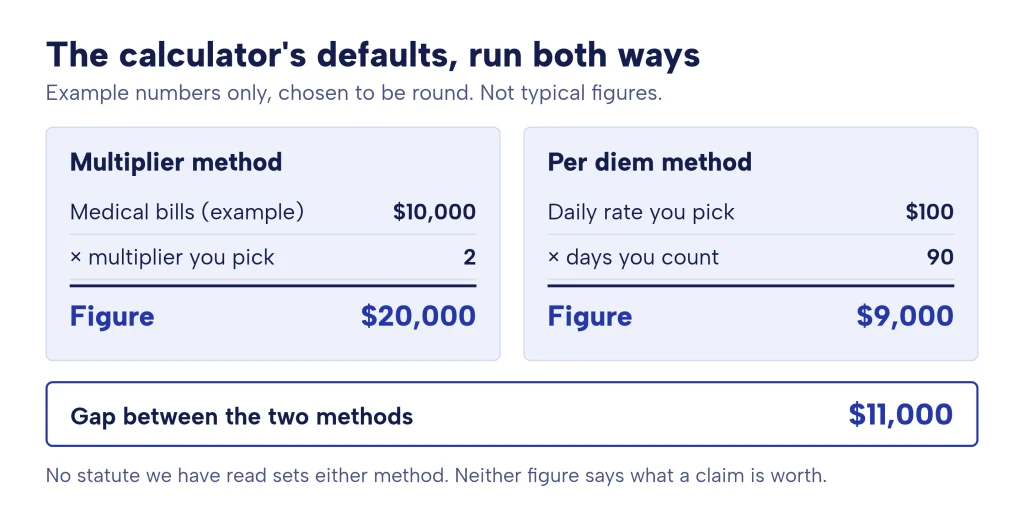
Two things stand out. The two methods, fed numbers that look modest, land $11,000 apart. And the multiplier figure works out at $222.22 a day over the same 90 days, more than twice the daily rate chosen. Neither number is right or wrong. Each follows from a choice, and the choice is the whole argument.
Change one entry and see how far things move. With the same bills, each extra 1.0 on the multiplier adds $10,000. With lost pay of $2,500 entered and the box ticked, a multiplier of 2 gives $25,000 instead of $20,000. With a different day count, the per diem figure moves in step: 180 days at $100 is $18,000.
What “pain and suffering” means in law
Pain and suffering is the everyday name for part of what the law calls non-economic damages (also called noneconomic loss or general damages): harm that has no bill attached. Statutes define it in similar words. New York’s no-fault law says “‘Non-economic loss’ means pain and suffering and similar non-monetary detriment” (N.Y. Ins. Law 5102(c)). Ohio’s definition includes pain and suffering, loss of society and companionship, disfigurement, mental anguish “and any other intangible loss” (Ohio Rev. Code 2315.18(A)(4)). Alaska lists “pain, suffering, inconvenience, physical impairment, disfigurement, loss of enjoyment of life, loss of consortium, and other nonpecuniary damage” (Alaska Stat. 09.17.010(a)). All three read on 6 November 2026.
Economic damages are the other part: medical bills, lost pay and other costs you can add up. That split is why multiplier calculators, ours included, start from your bills. The bills are the part of an injury that comes with a number.
When a case reaches a jury, the jurors set the non-economic figure. California’s instruction, quoted above, goes on: “You must use your judgment to decide a reasonable amount based on the evidence and your common sense” (CACI 3905A). A separate instruction tells California jurors that “The arguments of the attorneys are not evidence of damages” (CACI 3925). Other states have their own jury instructions; we quote California’s because we read its official text, the Judicial Council’s 2026 edition, on 6 November 2026.
The multiplier method
The multiplier method takes economic losses and multiplies them by a number, usually said to rise with how serious and lasting the injury is. It is quick, which may be why it shows up on nearly every calculator online.
You may see “pain and suffering is 1.5 to 5 times medical bills” on law firm pages, often with a table of injuries and multipliers. We looked for a statute, a court rule or a published study behind that range and didn’t find one. It is a rule of thumb that no law sets. The same goes for tables that pair an injury with a “usual” multiplier or a dollar range: we found no public dataset of settlement amounts, so there is nothing to check such tables against, and we don’t publish any.
Some pages also say insurers run claims through evaluation software that sets the figure. We found no public, primary description of how any insurer’s software values pain, so we can’t tell you how it works or whether it uses a multiplier at all.
What the arithmetic can show is how sensitive the result is. The figure moves in direct proportion to both the base and the multiplier. Moving from 2 to 3 adds half again. Adding lost pay to the base raises the result by the lost pay times the multiplier. If two people disagree about a pain and suffering figure built this way, they are usually disagreeing about one of those two choices.
The per diem method
Per diem means “per day”. This method picks a dollar amount for each day of pain and multiplies it by the days counted. Two choices drive it:
- The daily rate. Some pages suggest a day’s pay, on the reasoning that a day of pain is worth at least a day of work. That is an argument, not a rule. If you enter your yearly pay, the calculator shows it per calendar day so you can see what that argument produces.
- The days. From the injury until a doctor’s release? Until the last treatment? Only days with real limits? Future days, if a condition is expected to last? Each answer gives a different count, and the record that backs it up (treatment notes, a release date) matters more than the arithmetic.

Per diem suits a recovery with a clear start and end. It gets harder with a lasting condition, where “days” could run for years and the total grows large and easy to dispute. That is one reason the calculator shows both methods side by side, and the gap between them.
State laws that can cut or rule out pain and suffering
Before any multiplier matters, the law in your state may decide whether a pain and suffering claim exists at all, how fault changes it, and whether it is capped. The calculator applies none of these rules. Here is what we read, and where we stopped.
No-fault thresholds after a car crash
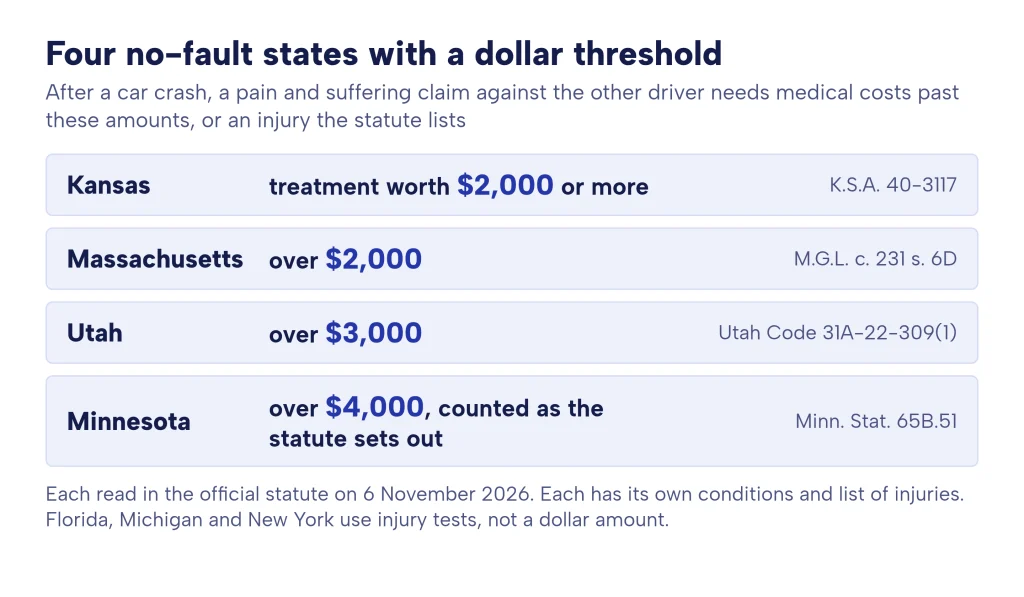
In some no-fault states, a person hurt in a car crash can claim pain and suffering from the other driver only if the injury passes a threshold set in statute. Below it, that claim isn’t available. Several thresholds are dollar amounts of medical expenses, so the first box in the calculator can matter in a way no multiplier does. Each row was read in the official statute on 6 November 2026; read the full section, because each has conditions and definitions of its own.
| State | Pain and suffering claim against the driver only if | Statute (read 6 Nov 2026) |
|---|---|---|
| Florida | Significant and permanent loss of an important bodily function; permanent injury within a reasonable degree of medical probability (other than scarring or disfigurement); significant and permanent scarring or disfigurement; or death | Fla. Stat. 627.737(2) |
| Kansas | Medical treatment with a reasonable value of $2,000 or more, or a listed injury: permanent disfigurement, certain fractures, loss of a body member, permanent injury, permanent loss of a bodily function, or death | K.S.A. 40-3117 |
| Massachusetts | Reasonable and necessary medical expenses over $2,000, or death, loss of a body member, permanent and serious disfigurement, certain loss of sight or hearing, or a fracture | M.G.L. c. 231 s. 6D |
| Michigan | Death, serious impairment of body function, or permanent serious disfigurement. No damages under this section for a person more than 50% at fault, or for a person driving their own vehicle without the insurance the law requires | MCL 500.3135(1), (2)(b), (2)(c) |
| Minnesota | Medical expenses, counted as the statute sets out, over $4,000, or permanent disfigurement, permanent injury, death, or disability for 60 days or more | Minn. Stat. 65B.51, subd. 3 |
| New York | A “serious injury”: death, dismemberment, significant disfigurement, a fracture, loss of a fetus, or listed permanent or significant limitations of use. The former 90/180-day category is gone for suits filed from 26 May 2026 | Ins. Law 5104(a), 5102(d) |
| Utah | Death, dismemberment, permanent disability or impairment based on objective findings, permanent disfigurement, a bone fracture, or medical expenses over $3,000. Applies to a person who has or must have personal injury protection; the threshold does not apply to an uninsured motorist claim | Utah Code 31A-22-309(1) |
Other states also have no-fault or “choice” rules, and some drivers chose a policy that limits their right to sue. We haven’t re-read those statutes for this page, so they are not confirmed here. Our no-fault lookup by state shows what we have read, with the statute and date for each state.
Your own share of fault
If you were partly at fault, the rules differ by state. In the states we have read, a share of fault usually reduces damages, some states bar the claim past a set share, and a few bar it for any fault at all; our fault rule lookup shows each one we have read. Two rules aimed squarely at non-economic damages:
- Michigan: if the injured person’s fault is greater than everyone else’s combined, the court reduces economic damages by that share “and noneconomic damages shall not be awarded” (MCL 600.2959, read 6 November 2026).
- New York: in a car crash suit under the no-fault article, non-economic loss is limited to $100,000 for an injured person who was at fault and was driving an uninsured vehicle (lapses under 30 days excepted), was impaired and convicted, or was committing a felony and convicted. The limit doesn’t apply to death cases (Ins. Law 5104(d), read 6 November 2026; added by the 2026 law that applies to suits filed from 26 May 2026).
Caps on non-economic damages
Some states cap non-economic damages in ordinary injury cases, not only in medical malpractice. These are ceilings on what a court can award, not estimates of value, and in Maryland and Ohio the jury isn’t told about the cap. We read three of them in full:
| State | Cap as written | Statute (read 6 Nov 2026) |
|---|---|---|
| Alaska | $400,000 or the injured person’s life expectancy in years × $8,000, whichever is greater. For severe permanent physical impairment or severe disfigurement: $1,000,000 or life expectancy × $25,000, whichever is greater | Alaska Stat. 09.17.010 |
| Maryland | $500,000 for causes of action arising from 1 October 1994, plus $15,000 each 1 October since 1995. By our arithmetic: $500,000 + 32 × $15,000 = $980,000 for causes arising 1 October 2026 to 30 September 2027 ($965,000 for the year before). Wrongful death with two or more claimants: 150% of that figure. Doesn’t apply to verdicts under Title 3, Subtitle 2A (health care malpractice claims) for causes arising from 1 January 2005 | Cts. & Jud. Proc. 11-108 |
| Ohio | The greater of $250,000 or three times economic loss, up to $350,000 per plaintiff and $500,000 per occurrence. No cap for permanent and substantial physical deformity, loss of use of a limb, loss of a bodily organ system, or a permanent physical functional injury that permanently prevents the injured person from caring for themselves independently. The section doesn’t apply to medical, dental, optometric or chiropractic claims, wrongful death actions, or suits against the state in the court of claims or against political subdivisions | Ohio Rev. Code 2315.18 |
Ohio’s cap is the only place we found a multiple of economic loss written into a statute, and it is used as a ceiling, never as a measure of what pain is worth. Other states’ caps, including the many that apply only to medical malpractice, are not covered here: we don’t list caps we haven’t read, and a cap’s current force can turn on court decisions. If a cap could matter, ask a lawyer or the court.
Insurance limits
A figure on paper and money that can be collected are different things. If the person at fault has a small liability policy and few assets, the policy limit can end the discussion long before any multiplier does. Our settlement calculator takes your own figures and applies a fault share and a policy limit you enter, line by line.
Is money for pain and suffering taxed?
It depends on where the pain came from. The tax code excludes damages, other than punitive damages, received “on account of personal physical injuries or physical sickness” (26 U.S.C. 104(a)(2)). IRS Publication 4345 (Rev. 9-2023) says money for emotional distress that comes from a physical injury is treated the same way, while money for emotional distress that doesn’t come from a physical injury is income, reduced by related medical costs that haven’t already cut your tax. Punitive damages and interest are taxable, and the part of a settlement that covers medical costs you deducted in an earlier year is income to the extent that deduction cut your tax (IRS Pub 4345, read 6 November 2026). Our guide to whether injury settlements are taxable goes through each part. A tax professional can say how it applies to you.
What any calculator leaves out
- Proof. A figure means little without records behind it: treatment notes, the dates of a doctor’s release, what you couldn’t do and for how long. Follow your treating clinician on care; this page gives no medical advice.
- Who decides. In a settlement, the figure is whatever both sides agree to. At trial, the jury or judge decides, within any cap.
- What comes off. Lawyer fees, case costs and liens from health plans, Medicare or Medicaid can come out of a settlement before you see it. Our what-you-keep calculator takes those off line by line with your own numbers.
- Time. Injury claims have deadlines to file suit that differ by state and by claim, and claims against a government body often need written notice within months. None of the arithmetic matters if a deadline passes. Our injury deadlines by state show each statute we read and its exceptions.
Your next step
Gather the numbers the calculator needs from real documents: medical bills and statements, pay stubs or a letter from your employer, receipts. Write down the date of the injury, your treatment dates, and the date you were released or expect to be. Then run the calculator with more than one multiplier and day count, so you can see the spread rather than a single figure.
Check whether a no-fault threshold, a fault rule or a cap applies in your state, using the rows above or the statute itself. Check the deadline first if you haven’t, because that can’t wait, and a claim against a government body or for a child can run on different rules. Questions about your own claim are for a lawyer licensed in your state. If cost is a concern, legal aid organizations and your state court’s self-help pages can point you to help.
Sources checked on 6 November 2026.
Formulas and sources
- Multiplier base: Judicial Council of California Civil Jury Instructions (2026), CACI 3905A: no fixed standard for noneconomic damages
- Multiplier method: base times your multiplier: Arithmetic on the reader's own entries. No law sets a multiplier or a daily rate
- Per diem method: daily rate times days: Arithmetic on the reader's own entries. No law sets a multiplier or a daily rate
- Gap between the two methods: Arithmetic on the reader's own entries. No law sets a multiplier or a daily rate
- Your economic losses entered: Arithmetic on the reader's own entries. No law sets a multiplier or a daily rate
- Losses entered plus the multiplier figure: Arithmetic on the reader's own entries. No law sets a multiplier or a daily rate
- Losses entered plus the per diem figure: Arithmetic on the reader's own entries. No law sets a multiplier or a daily rate
- Multiplier figure spread over your days: Arithmetic on the reader's own entries. No law sets a multiplier or a daily rate
- Your yearly pay per calendar day: Arithmetic on the reader's own entries. No law sets a multiplier or a daily rate
Sources
- Judicial Council of California Civil Jury Instructions, 2026 edition (CACI 3905A, 3925)
- New York Insurance Law 5102 (definitions, serious injury)
- New York Insurance Law 5104 (non-economic loss)
- Ohio Revised Code 2315.18
- Alaska Statutes 09.17.010
- Maryland Courts and Judicial Proceedings 11-108
- Florida Statutes 627.737
- Kansas Statutes 40-3117
- Massachusetts General Laws c. 231 s. 6D
- Michigan Compiled Laws 500.3135
- Michigan Compiled Laws 600.2959
- Minnesota Statutes 65B.51
- Utah Code 31A-22-309
- 26 U.S.C. 104 (Cornell LII copy)
- IRS Publication 4345, Settlements: Taxability (Rev. 9-2023)